It’s been more than 100 years since Lewis Fry Richardson first attempted to calculate a weather forecast using a technique now known as numerical weather prediction (NWP). However, the technique really took off in the second half of the 20th century at the dawn of the microprocessor era. Today, artificial intelligence (AI) based weather forecast models are quickly becoming popular.
Weather forecasting has made considerable strides in recent decades, so much so that it is now possible to produce tangible skill in forecasts with a lead time of three to six weeks or even more.
As forecasting skills improve across all lead times, new opportunities emerge to provide innovative and valuable services. Founded in 2009, the World Climate Service is positioned to be a leader in the exciting developments and upcoming growth of long-range weather and climate forecasting.
- Deterministic Weather Forecasting
- Deterministic Forecasting Has a Limit
- Long-Range Weather Forecasts – Sources of Predictability
- Long-Range Forecasting Time Scales
- Use of output from long-range forecasts
- Real-world Long Range Forecast Success: The World Climate Service
- References
- What is a Climate Index?
- What is the El Niño/Southern Oscillation (ENSO)?
- What is the North Atlantic Oscillation (NAO)?
- What is the Pacific Decadal Oscillation (PDO)?
- What is the Indian Ocean Dipole (IOD)?
- What is the Madden-Julian Oscillation (MJO)?
- What is the Arctic Oscillation (AO)?
- What is the Pacific North America Pattern (PNA)?
- What is the Scandinavian Pattern Climate Index (SCAND)?
- What is the Eastern Atlantic/Western Russia Pattern (EA/WR)?
- What is the Stratospheric Polar Vortex (SPV)?
- What is the Quasi-Biennial Oscillation (QBO)?
- What is the Eastern Pacific Oscillation (EPO)?
- What is the Western Pacific Oscillation (WPO)?
- What is the Atlantic Multi-decadal Oscillation (AMO)?
- What is the Northeast Pacific Mode (NPM)?
- What is the Tropical North Atlantic Index (TNA)?
- What is the Southern Angular Mode (SAM)?
- What is the Asian-Bering-North American Index (ABNA)?
Deterministic Weather Forecasting
In 2020, the global energy industry depends on high-quality weather forecasts for critical decision-making like never before. Over recent decades, the application of these forecasts has expanded exponentially due to the rapid growth of renewable energy and the liberalization of energy markets.
Short-range forecasts are now an essential tool in the real-time management of wind and solar assets, whilst medium-range forecasts play a crucial role in daily hedging activity. Even though modern computing power has brought huge improvements to forecast accuracy, there remains an inconvenient truth at the heart of traditional weather forecasting: there is still very little deterministic skill in the long term, generally considered a forecast beyond 12 days ahead. Enter the long-range forecast.
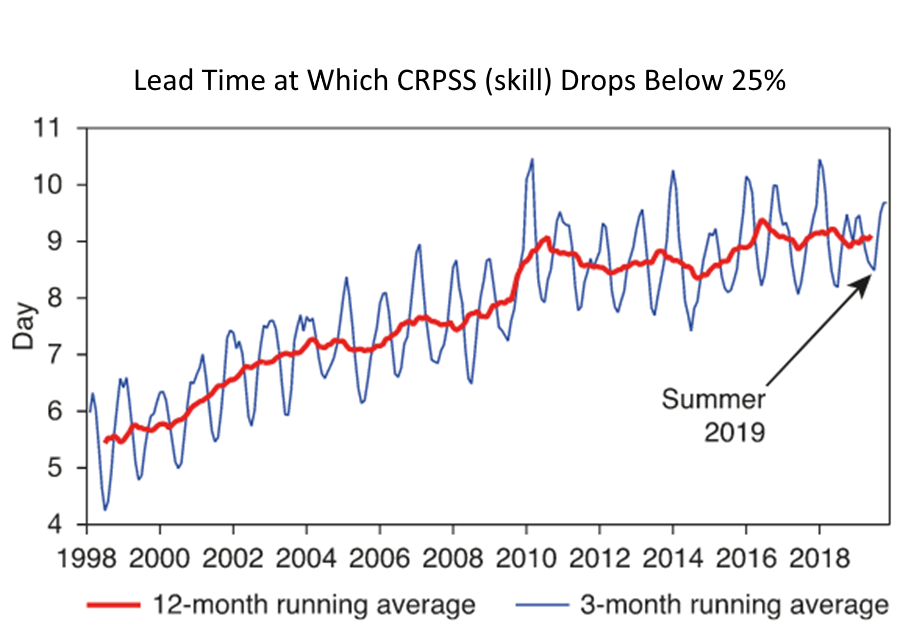
The time horizon, in days, at which skill (CPRSS) drops below 25% (from ECMWF). Improvements over the last decade have been modest despite significant increases in computing power.
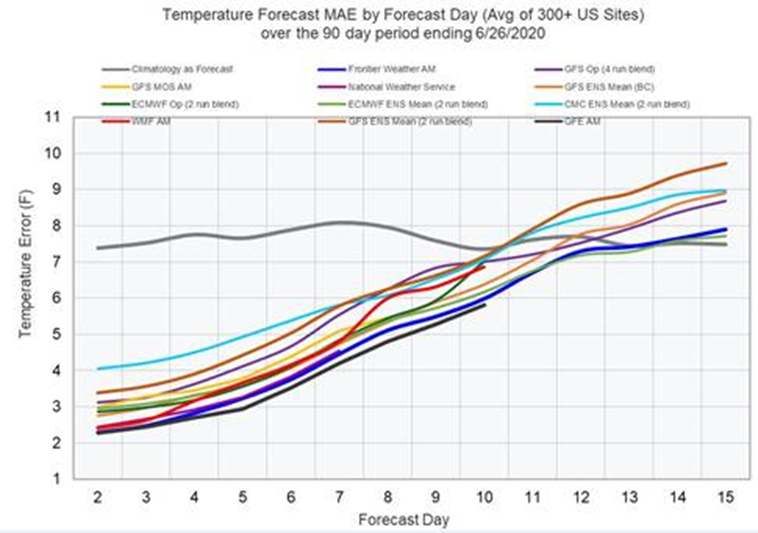
Average error of T2m by lead time: all models are no better than climatology (gray line) by day 12. Provided by https://www.frontierweather.com.
Deterministic Forecasting Has a Limit
This dynamical modeling method has proven to be a spectacular success in the short to medium range, i.e., from a few days up to 12 or so days into the future. However, Dr Zhang confirmed that the 2-week barrier for deterministic forecasts can never be penetrated, even if all the computing power in the world were applied to create a forecast.
Fortunately, an innovative and exciting new forecasting approach has taken the world by storm in recent years, challenging traditional norms and transforming the landscape of long-range forecasting.
Long-Range Weather Forecasts – Sources of Predictability
Traditional medium-range weather forecasting is an atmospheric initial value problem – in other words, if we know the initial state of the atmosphere globally, we can use weather forecast models to predict the future. That weather forecast model is a set of equations that describes the behavior of the atmosphere.
Long-range weather forecasting, compared to deterministic forecasts, relies more on the predictability offered by boundary conditions. Example boundary conditions include the temperature of the ocean surface and the extent of ice surfaces that are in contact with the atmosphere. These boundary conditions influence the atmosphere over weeks to months, with the ocean being the most important. Thus, a component of long-range forecasting is sometimes considered to be an oceanic initial value problem.
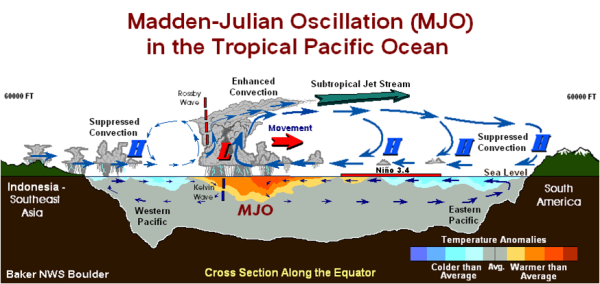
Other sources of long-range predictability include the state of the stratosphere (Baldwin and Dunkerton 2001) and the quantity of moisture in near-surface soils (Koster et al. 2010).
Long-Range Forecasting Time Scales
Long-range forecasts are generally split into two periods:
- Sub-seasonal (sometimes referred to as the “extended” range) covers 2 to 6 weeks into the future. The smallest denomination of the forecast is usually one week, and consecutive weeks can be combined. The WCS offers a comprehensive set of sub-seasonal tools and forecast products.
- Seasonal covers the period 1 to 9 months ahead. The smallest denomination of this forecast is usually one month, and the forecasts are often presented in 3-month blocks (or seasons). The WCS releases high-quality seasonal outlooks (3-month blocks) each month for temperature and precipitation for North America, Europe and East Asia.
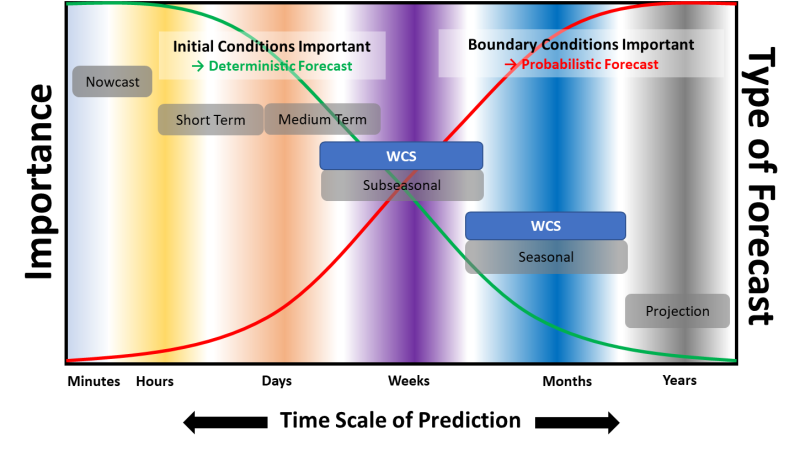
The forecasting time spectrum: the WCS specializes in probabilistic long-range weather forecasts in the sub-seasonal to seasonal range, which leverage skill contained within the boundary conditions.
Use of output from long-range forecasts
Long-range weather forecasts and seasonal outlooks do not attempt to give us the detail we are used to in traditional weather forecasts (deterministic and ensemble forecasts), as the daily variation of weather, such as temperature and precipitation, by both location and time, cannot be resolved. What can be detected is the probability of certain anomalies over longer time periods and wider areas. Thus, long-range weather forecasts are probabilistic rather than deterministic. Consequently, WCS seasonal outlooks are issued with a confidence level. When statistical factors align, the forecast is more confident, and confident forecasts of specific outcomes are more likely to verify correctly.
The seasonal outlook is often presented in terms of 3 terciles of a probability distribution: below normal, near normal, and above normal. On average, each category has a 33% chance of happening in any given week/month/season. As the forecast is framed in terms of the probability of outcomes, the user does need some understanding of risk associated with each outcome. The user also needs to understand how they will act to mitigate that risk.
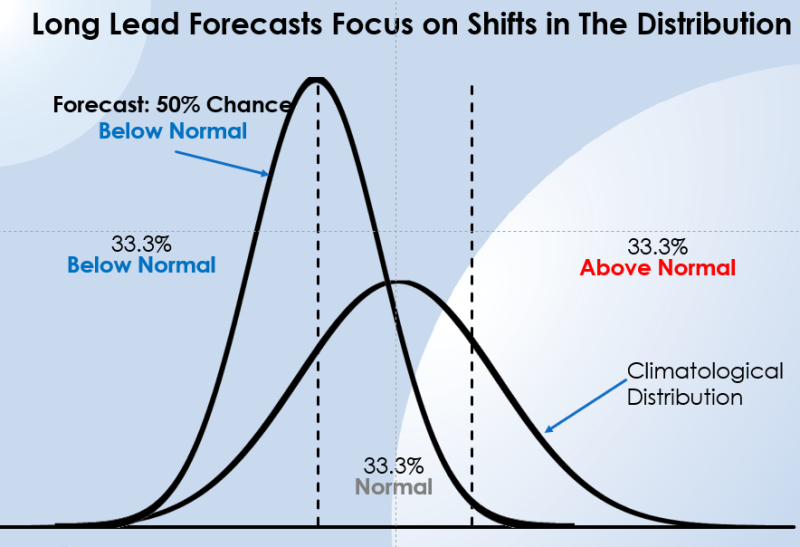
A probabilistic long-range weather forecast is framed in terms of the relative chances of the 3 terciles occurring. In this example the chance of below normal is 50% – significantly higher than usual.
Long-Range Forecast: Types of application
There are numerous societal and economic benefits from the application of long-range weather forecasts.
Energy Trading and Gas and Electric Utilities: Both energy supply and demand are intricately linked to weather variations. Any business involved in managing energy resources or responsible for the security of energy supply will have a keen interest in the long-range weather forecast.
Natural resources: the burgeoning global population means that careful management of natural resources such as water has never been more important. Water companies routinely use long-range weather forecasts to optimize their planning strategies.
Agriculture: the long-range weather forecast enables farmers to take timely actions to manage their crops, optimize yield, and guard against disease.
Emergency planning: agencies charged with protecting life and property will have a keen interest in long-range weather forecasts, enabling them to prepare and access the necessary resources in the coming weeks and months.
Real-world Long Range Forecast Success: The World Climate Service
Traditional weather forecasting has been around for more than half a century and is improving slowly towards a known limit of predictability as computing power increases. The long-range forecast, including subseasonal and seasonal climate forecasts, on the other hand, is the new kid on the forecasting block. The WCS has been at the forefront of the rapid progress seen over the last 20 years; having started from a modest skill base in temperature and precipitation prediction, we now see significant, tangible, and actionable skill in a range of weather parameters.
Request a trial of the World Climate Service today.
References
Baldwin and Dunkerton, 2001. Stratospheric Harbingers of Anomalous Weather Regimes.
Cassou, 2008. Intraseasonal interaction between the Madden-Julian Oscillation and the North Atlantic Oscillation.
Koster et al., 2010. Contribution of land surface initialization to subseasonal forecast skill: First results from a multi-model experiment.